


 1 hour ago
1
ADVERTISE HERE
RETURNING to Sibu to spend time with his ageing parents opened an unexpected path from farming to Silicon Valley.
For William Hu, founder and executive director of NEX EcoVentures Sdn Bhd, that journey has led to an opportunity to represent Sarawak and Malaysia at the Startup World Cup Grand Finale in November 2026, following his company’s victory at the Startup World Cup Malaysia 2026 East Chapter.
Before returning from Singapore in 2018, he had spent about 15 years in corporate services and the company secretarial profession in Malaysia and Singapore.
Nobody in his immediate family came from an entrepreneurial background, and he had never imagined establishing a business, much less one involving agriculture, food processing and agro-industrial waste conversion.
“It was never my intention to become an entrepreneur, let alone to build a sustainability-driven business,” he recalled.
Learning to farm from scratch
Hu’s introduction to agriculture began when he and his brother Henry started distributing liquid organic fertiliser.
Many farmers they met were reluctant to invest in irrigation systems and adopt more systematic farming methods, making it difficult for the brothers to demonstrate the potential benefits of what they were promoting.
Rather than continue explaining what might work, they decided to put those practices to the test themselves.
“So we started farming,” he said.
They were joined by Just Lau, a NEX co-founder whose responsibilities now cover food manufacturing and research and development,
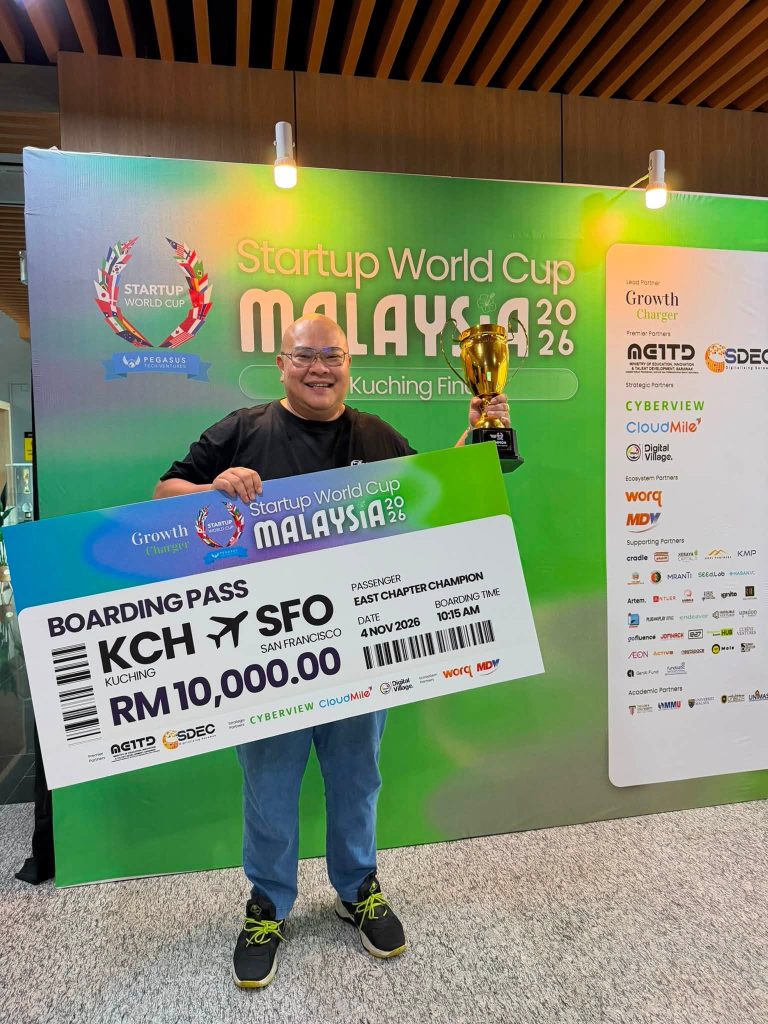 William Hu
Hu came from corporate services, Henry had worked in logistics and information technology, while Lau’s background was in programming and IT solutions.
“We had enthusiasm, but very little agricultural experience,” he recalled.
Their search eventually introduced them to Sacha Inchi, a South American crop which he described as naturally rich in plant-based Omega 3, 6 and 9 fatty acids, as well as protein.
After visiting a farm in Johor, they began cultivation trials in Sarawak.
But turning an unfamiliar crop into a business took time, and the team still needed income to sustain its operations.
“We could believe in Sacha Inchi, but belief does not pay salaries, electricity or operating expenses,” he said.
The team therefore planted conventional cash crops alongside its Sacha Inchi trials.
“Sometimes the business that keeps you alive today is what gives you the opportunity to build the business you believe in tomorrow,” he said.
He hoped that establishing suitable cultivation practices, developing downstream products and building market demand could eventually support a contract farming model involving rural communities.
However, Hu did not believe other farmers should be encouraged to invest in an unfamiliar crop simply because the company considered it promising.
“First create the market. Then create the opportunity for more people to participate in supplying that market,” he said.
While the team continued exploring Sacha Inchi’s potential, another possibility emerged from an unexpected conversation in December 2019.
A Christmas dinner and a new direction
During a Christmas dinner with someone from the palm oil milling industry, Hu found himself discussing palm oil biomass, particularly a processing residue known as decanter cake.
Coincidentally, he said a friend of his was experimenting with soybean waste as feedstock for Black Soldier Fly larvae.
The two developments prompted him and his partners to consider whether a similar biological process could be applied to palm oil biomass.
“Could Black Soldier Fly bioconversion work with palm oil biomass?”
The question marked the beginning of their agro-industrial waste research, introducing another area of work alongside the farming activities they had already undertaken.
By February 2020, the team had moved its Sacha Inchi trials towards commercial cultivation while beginning more serious research and development into Black Soldier Fly bioconversion.
Then the COVID-19 pandemic arrived.
Although the lockdown disrupted normal activities, he said it also gave the team time to experiment with Sacha Inchi harvested from its trial plot.
“Instead of selling agricultural produce only in its raw form, what else could we create from the same plant?” he recalled.
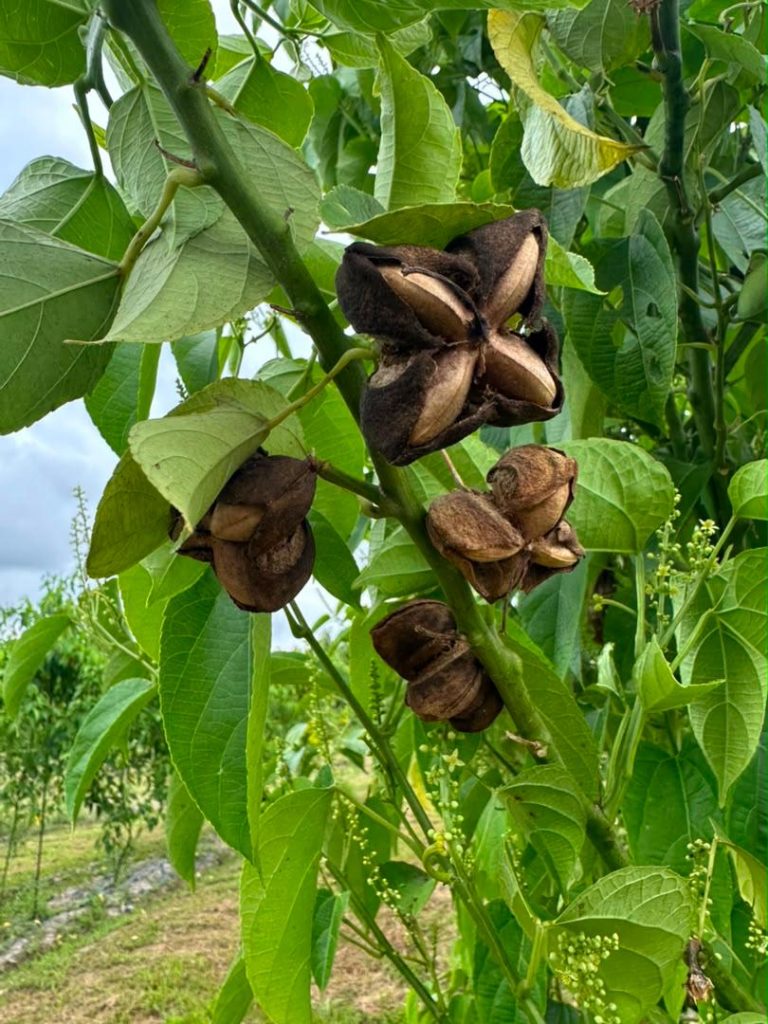 Sacha Inchi seed pods growing on a vine.
Those experiments marked the beginning of their agro-food processing activities, eventually leading to the development of Sacha Inchi oil, roasted nuts, tea and beverages.
For him, developing these products provided one of the first indications that their agricultural activities could become a commercially viable business.
The same thinking informed their research into whether biological conversion could recover protein, lipids and organic soil inputs from palm oil biomass.
“The opportunity was not merely sustainability. The opportunity was creating more value from resources that already exist,” he said.
However, pursuing opportunities in food processing and agro-industrial bioconversion presented another challenge for the relatively small company.
The team lacked sufficient capital to employ all the researchers, establish laboratories or independently undertake every research programme needed to investigate and validate its ideas.
Rather than attempting to develop every capability internally, Hu and his partners sought collaborations with universities, researchers and institutional partners.
He said the timing also worked in the company’s favour as sustainability, circular economy practices, food security and alternative biological resources gradually gained greater attention as national priorities.
What began as a financial limitation eventually influenced the company’s approach to research and development.
“You do not need to own every capability, but you need to know how to bring the right capabilities together,” he said.
In 2024, the group brought these activities under a clearer identity and rebranded as NEX EcoVentures.
According to Hu, NEX represents Noble, Exceptional and Excellence.
He said the principles reflected creating value beyond the company, finding new uses for resources and ensuring products could compete on quality and commercial terms.
By then, what had begun with three newcomers trying to demonstrate farming practices had developed into a business spanning primary agriculture, agro-food processing and agro-industrial bioconversion.
Asked what had turned out differently from his initial expectations, his answer was brief.
“Almost everything.”
Knowing when to continue and when to walk away
Among NEX’s different activities, Hu found that agro-food products were generally easier for customers to understand.
“NEX markets Sacha Inchi oil, tea, roasted nuts and beverages through our GINHO business to consumers, retailers and distributors,” he said.
Black Soldier Fly bioconversion has proved harder, involving regulatory considerations, animal nutrition, feed formulation, production consistency, customer education and processing costs.
“If a conventional feed ingredient costs significantly less than an insect-based alternative, it is unrealistic to expect the customer to adopt the new ingredient purely because the environmental story sounds better,” he said.
NEX consequently moved towards a circular biorefinery model intended to recover value from several outputs rather than relying solely on larvae.
Its platform produces larvae and frass for animal nutrition and agriculture, while the company explores the higher-value potential of Black Soldier Fly-derived lipids.
He acknowledged that numerous projects had been reconsidered over the years, including products requiring reformulation and concepts for which the market was not yet ready.
Some were postponed, scaled back or left in the laboratory; others were abandoned.
“The bigger mistake would be falling in love with an idea simply because it is ours,” he said.
 William Hu
For Hu, deciding when to stop spending on a project is as important as identifying an opportunity worth developing.
He believes the company must consider what it can produce consistently, what customers want, what they can afford and which products can generate sufficient cashflow to support operations.
“Don’t dream about the nationwide market before you know whether the person beside you will buy the product,” he said.
Although Malaysia has more than 30 million consumers, he believes concentrating too early on nationwide ambitions can distract a small business whose production capacity and distribution network are still developing.
NEX has followed that approach by starting locally, learning from customers and strengthening production before expanding.
According to him, more than RM5 million has gone into building NEX and its operating infrastructure through a combination of their own capital, financing from financial institutions and soft financing support from the Sarawak Government.
The funds supported farming, machinery, food processing and Black Soldier Fly facilities, certification and research and development.
With much of the infrastructure in place, Hu said the challenge was now to turn that investment into repeat customer demand.
Building from Sibu
Having built NEX in Sibu, Hu said Sarawak shaped both the opportunities the company could pursue and the obstacles it encountered.
He considers the state’s land, biodiversity, agricultural resources, agro-industrial activities and renewable-resource potential important advantages for businesses involved in agriculture and biological resource development.
Beyond those resources, he believes political stability creates confidence for companies undertaking long-term investments.
“Agriculture, food manufacturing and biotechnology are not businesses where you invest today and recover everything tomorrow. They require patience,” he said.
He also credited the support of government agencies, universities and research institutions for creating opportunities in agricultural innovation, sustainability and commercialisation.
He said Sarawak’s ambitions in sustainable agriculture, technology, research and food security were increasingly aligned with NEX’s direction.
Closer to home, he pointed to the establishment of the Sibu Economic Zone and an initial RM1.5-billion allocation announced by the Premier as developments that encouraged him about the town’s economic future.
“For someone who came home to Sibu and built the business here, this is motivating,” he said.
According to him, his company is geographically further from many major markets, investors, specialist technology providers and industrial customers, while logistics can be more expensive and certain expertise harder to access.
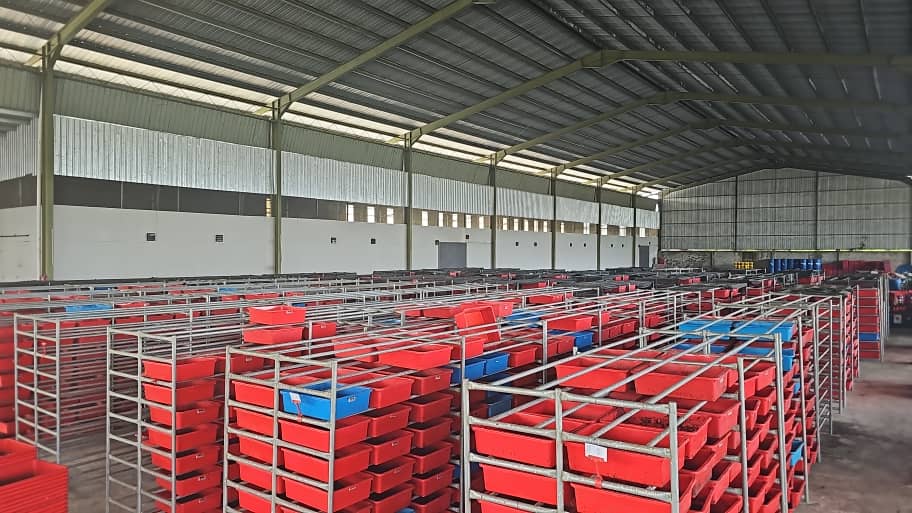 BSF breeding facility.
Hu said those difficulties had taught the team to collaborate and develop solutions themselves.
“Palm oil is one example of why location matters to us,” he said.
While recognising the industry’s importance to Malaysia’s economy, particularly in regions such as Sarawak, Hu also acknowledged the international criticism it has faced over sustainability and environmental impact.
“We cannot erase those criticisms simply by defending the industry.
“What we can do is continue improving the story,” he said.
He described his hopes for the industry’s future through an analogy involving punctuation.
“My hope is that one day, when someone writes about the criticisms surrounding palm oil, there can be a comma rather than a full stop at the end of that sentence.
“Palm oil has faced significant sustainability criticisms; however, its biomass also holds enormous potential as a biological feedstock for new proteins, organic agricultural inputs, renewable lipids and other higher-value industries.”
If even part of that potential can be demonstrated commercially, he believes materials previously regarded primarily as a waste-management problem could become the basis for additional economic opportunities.
“That is one reason we persisted with our Black Soldier Fly work even when the pathway was difficult,” he said.
Beyond the Silicon Valley competition
At the Startup World Cup Malaysia 2026 East Chapter, NEX presented its Circular Biorefinery Platform, which Hu said the company wanted the judges to recognise for its potential to recover greater value from underutilised biological resources.
During its presentation, the company highlighted figures of more than 20,000 tonnes of biomass diverted and more than 8,000 tonnes recovered, alongside a platform designed around a high level of resource circularity.
However, Hu said the figure he most wanted to see increase over the coming years was not simply the volume of biomass processed, but recurring commercial demand.
“Because research proves that something can work. The market proves whether it deserves to scale,” he said.
The presentation also touched on a longer-term possibility involving Black Soldier Fly-derived lipids and their potential relevance to the Sustainable Aviation Fuel (SAF) pathway.
Following initial laboratory work examining the characteristics of extracted oil, NEX secured research funding through Yayasan Sarawak for further investigations with Curtin University Malaysia.
However, Hu emphasised that the application remains under research rather than being an established commercial product.
“SAF is still a research journey for us, and I think it is important not to overstate where we are today,” he said.
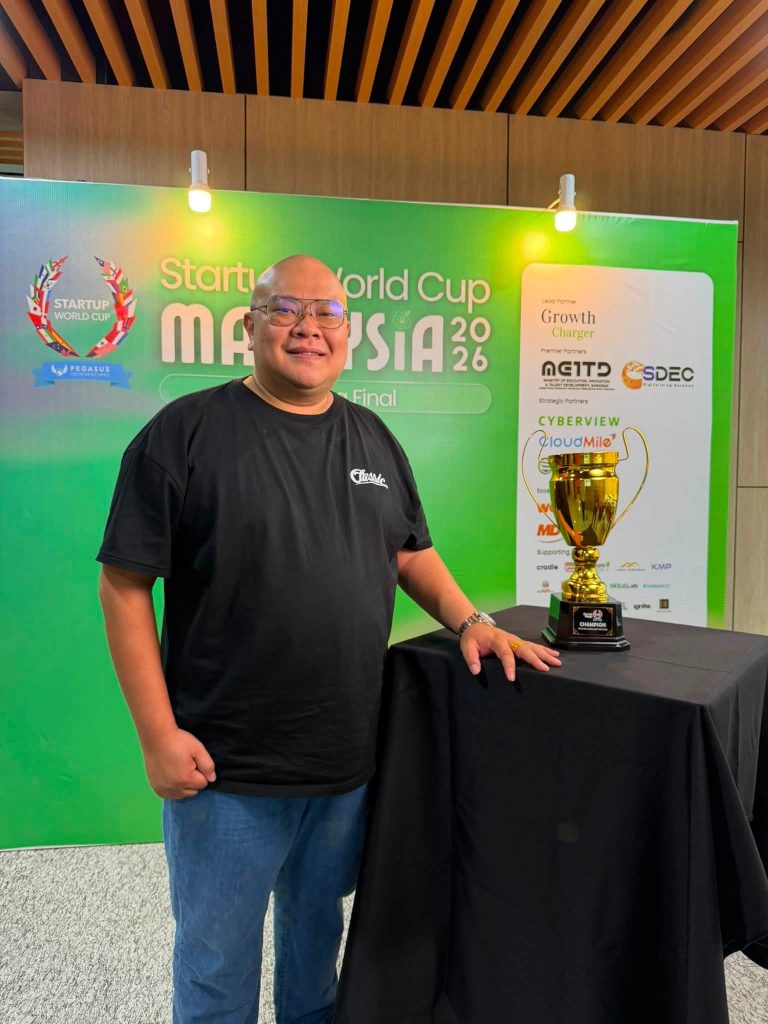 William Hu
For Hu, winning the East Chapter competition provided encouragement that the platform and the direction being pursued deserved further development, rather than proving that every potential application had already been established.
The victory has now given NEX an opportunity to represent Sarawak and Malaysia at the Startup World Cup Grand Finale in Silicon Valley in November 2026.
Hu said investment could accelerate commercialisation, but securing the right customers, industrial partners or access to overseas markets could be just as valuable.
“If San Francisco results in one serious investment discussion, one meaningful industrial collaboration or one credible pathway into an international market, that could have a much greater long-term effect than simply winning another trophy,” he said.
Beyond potential commercial partnerships, Hu hopes the trip will demonstrate that innovation with international relevance does not necessarily have to originate in established technology or business centres.
“It can begin with a farmer. It can begin beside a palm oil mill. It can begin because somebody looked at something called ‘waste’ and asked whether it could become a resource. And it can begin in Sibu, Sarawak,” he said.
Looking beyond the competition, Hu said the next two to three years would be crucial in determining whether NEX could move from an emerging startup into an established business.
For him, the measure would not be the company’s valuation, but its ability to operate consistently at meaningful commercial capacity, generate repeat demand and improve production economics so that customers purchase its products for their commercial value rather than solely their environmental benefits.
He also wants NEX to strengthen its business model by recovering value from multiple outputs, with the longer-term aim of replicating the platform developed in Sarawak elsewhere.
“The next chapter is therefore less about proving that science works. It is about proving that the business model works repeatedly,” he said.
Although the opportunity to represent Sarawak and Malaysia in Silicon Valley was something he had never envisaged when returning to Sibu, Hu does not regard the Startup World Cup victory as the completion of his entrepreneurial journey.
“I don’t see that as an arrival. I see it as another piece of validation,” he said.
“Sometimes it can start quietly, with limited resources, in a place like Sibu. What matters is whether you continue building.”



 English (US) ·